
Developing technically advanced FAIR and Open Science services is only the first step. Their long-term impact depends on whether researchers understand them, trust them and can integrate them into their everyday work.
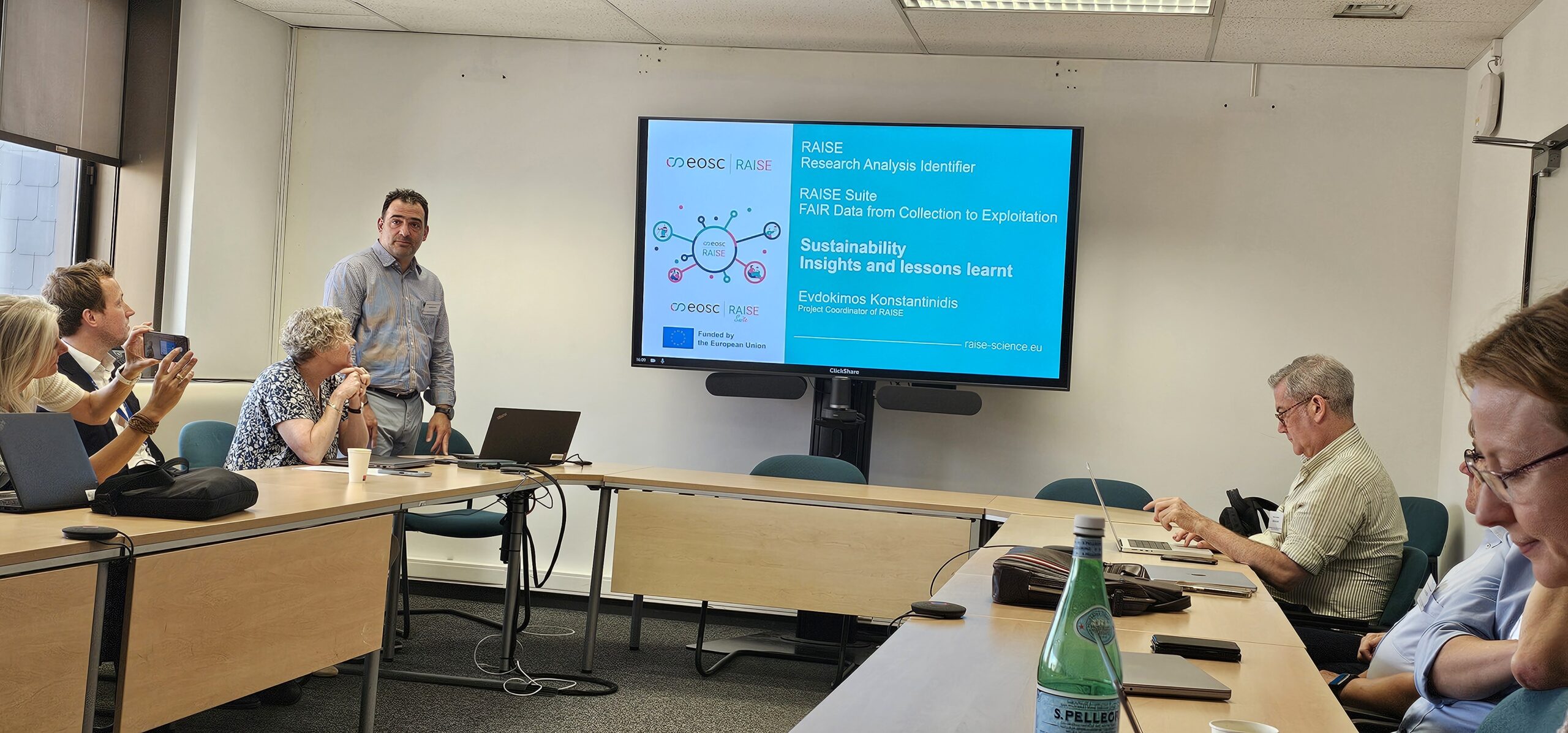
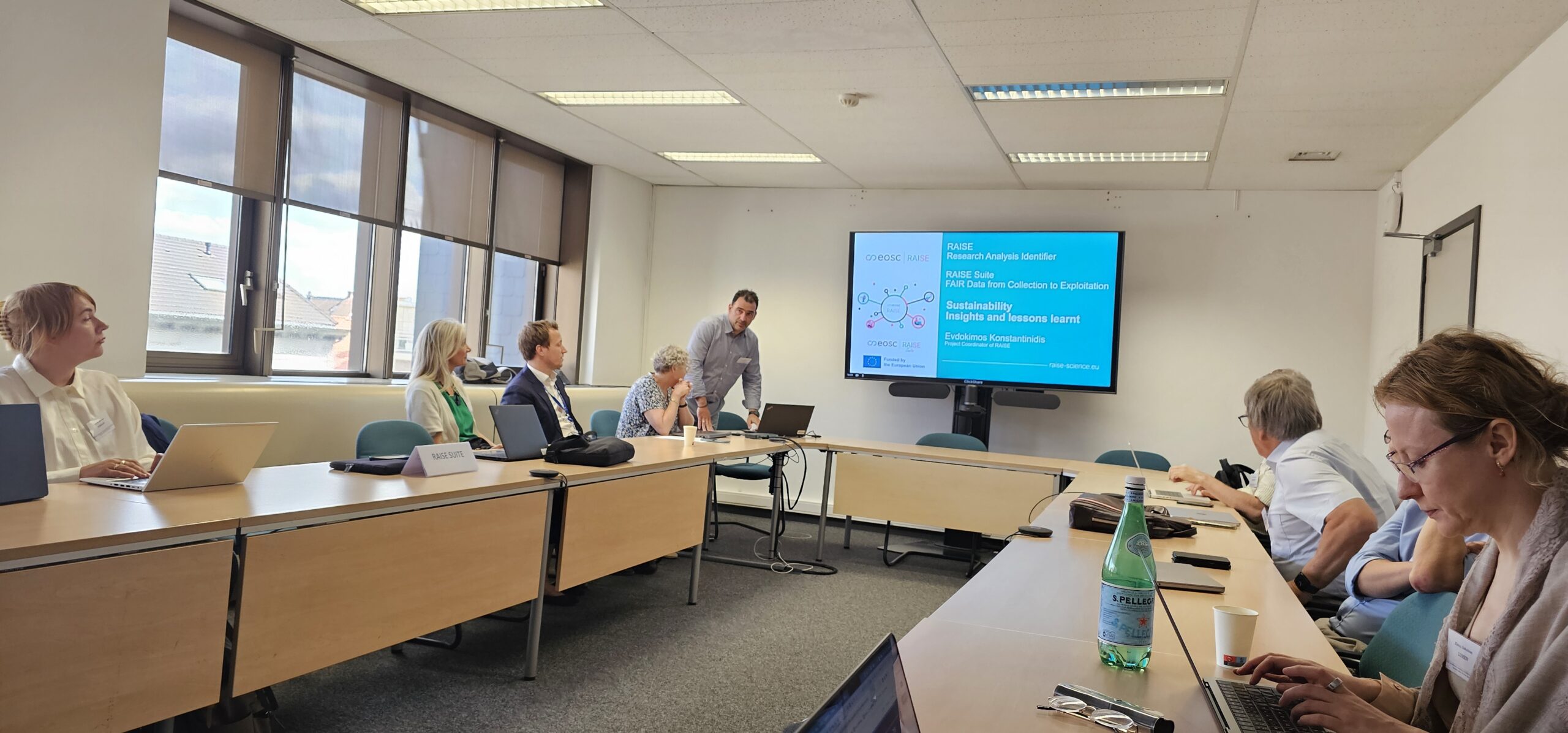
This question was at the centre of the contribution delivered by Evdokimos Konstantinidis, our Project Coordinator, during the breakout session “FAIR Data Ecosystems and Scientific Uptake” at the 2026 Coordination Meeting of EOSC-related projects:
How can FAIR and Open Science solutions move beyond successful technical development and achieve meaningful, sustainable adoption by researchers?
Drawing on lessons from the RAISE ecosystem, the presentation highlighted that scientific uptake depends on more than infrastructure. It requires user-centred design, practical training, real-world validation, sustainable continuation pathways and systematic collaboration across projects.
Technical infrastructure is only the foundation
RAISE has already developed a working technical environment that supports secure data processing, persistent identification and provenance tracking.
Through the live RAISE portal, source datasets, processing scripts and research results can be connected within a Trusted Execution Environment. Machine-actionable Data Management Plans can guide data-management processes, while provenance mechanisms document how data are collected, processed and reused.
This infrastructure supports transparency and reproducibility. However, technical maturity alone does not guarantee adoption. A service must also answer a simple question from the researcher’s perspective: Does this make my work easier and more valuable?
FAIR tools must reduce researchers’ workload
Researchers are more likely to adopt FAIR services when they fit naturally into existing workflows.
FAIR-related processes should therefore operate as seamlessly as possible in the background. Metadata, provenance and data-management information should be captured automatically wherever possible, rather than creating additional manual tasks. User-experience expertise is critical. Researchers should be involved in the design and testing of services, while new solutions should integrate with tools and research instruments that scientific communities already use.
The goal is not to ask researchers to adapt to complex FAIR technologies. It is to design FAIR technologies around the realities of research practice.
Open Science skills cannot be assumed
Scientific uptake also depends on researchers understanding the concepts behind the technology. Terms such as persistent identifiers, DOIs, ORCID, metadata and FAIR principles are not equally familiar across disciplines and career stages. Many students complete Bachelor’s or Master’s programmes without receiving practical training in research data management or Open Science.
Open Science education should therefore begin at university level. Training must be accessible to researchers and students who are not already familiar with EOSC. It should explain not only what FAIR practices are, but also how they improve visibility, reproducibility, collaboration and recognition. Embedding these skills into university programmes can help make good data-management practices a standard part of research rather than an additional obligation.
Uptake requires engagement beyond the EOSC community
FAIR data ecosystems should not be designed only for organisations that are already active within EOSC. Hospitals, regional authorities, Living Labs, technology providers and environmental organisations also generate and manage valuable data. Their participation helps identify practical barriers and extends Open Science into new communities.
RAISE Suite is testing its approach through six pilots covering:
- cancer-survivor monitoring;
- stroke transitional care;
- urban mobility;
- forestry;
- ocean and water monitoring;
- and food-waste management.
These pilots involve different instruments, data types, organisational settings and levels of Open Science awareness. They allow the project to assess whether the technology can be integrated into existing systems, whether it reduces effort and whether users would continue using it after the pilot ends. External validation will also be supported through Open Calls. Eight researchers will receive vouchers of €10,000 to integrate the RAISE Suite SDK into their own data-collection instruments. Their experience will provide independent feedback on usability, documentation, integration and transferability beyond the consortium.
Sustainability starts with real adoption
A technically compatible service is not automatically sustainable. Long-term uptake requires an active user community, clear ownership, maintenance responsibilities, governance and a realistic exploitation pathway. The presentation highlighted a shift in emphasis: service providers should focus first on delivering value and attracting real users, rather than concentrating mainly on convincing EOSC Nodes to host their services.
A possible mechanism discussed was that technically compatible services with more than 200 real users could qualify for more direct onboarding to EOSC Nodes. The principle is that demonstrated adoption provides evidence of genuine research value. Projects must also communicate their unique role clearly. New services should not unnecessarily compete with mature platforms, instead, they should address unmet needs and complement established solutions.
RAISE, for example, is not a marketplace or a source-code versioning platform. Its value lies in secure processing, provenance and enabling data to become open for processing.
Business development must begin early
Another important point made during the presentation was that sustainability cannot be addressed through communication and dissemination alone. Projects also need business-development expertise to define value propositions, identify users, analyse competing solutions and explore continuation opportunities. These pathways may include follow-on Horizon Europe funding, commercialisation support or instruments such as EIC Transition for results with strong innovation potential.
The continued development of the RAISE family, through RAISE Science, RAISE Suite and RAISE Connect, demonstrates the importance of building on previous investments, technologies and communities instead of starting again when a project ends.
Collaboration should become systematic
The presentation concluded with two concrete opportunities for cross-project collaboration:
- The first is a common methodology for assessing Open Science impact. RAISE has developed validated questionnaires that examine changes in researchers’ confidence, attitudes and concerns around data sharing and reuse.
- The second is AI-supported collaboration matching. Through the RAISE collaborative requirements platform, project activities can be automatically compared to identify potential joint events, pilots, training sessions or technical developments.
Scientific uptake is an ecosystem outcome. It requires reliable infrastructure, but also intuitive design, practical skills, real-world testing, engaged communities and clear sustainability pathways. The experience of RAISE shows that FAIR and Open Science solutions achieve lasting impact when they are not only technically advanced, but also useful, trusted and embedded in everyday research practice.