As the RAISE Suite project continues to evolve, establishing a robust, automated, and scalable data management framework remains a top priority. Recently, our consortium held two key events, a Data Management Plan (DMP) webinar and a technical coordination meeting, to inform our partners about latest developments on machine-actionable DMPs (ma-DMPs) resulting from RDA and OSTrails activities and outline the technical requirements for integrating with ARGOS/OpenCDMP software. Here is a summary of our discussions and progress set for the road ahead.
Aligning Our Methodology: The maDMP Webinar
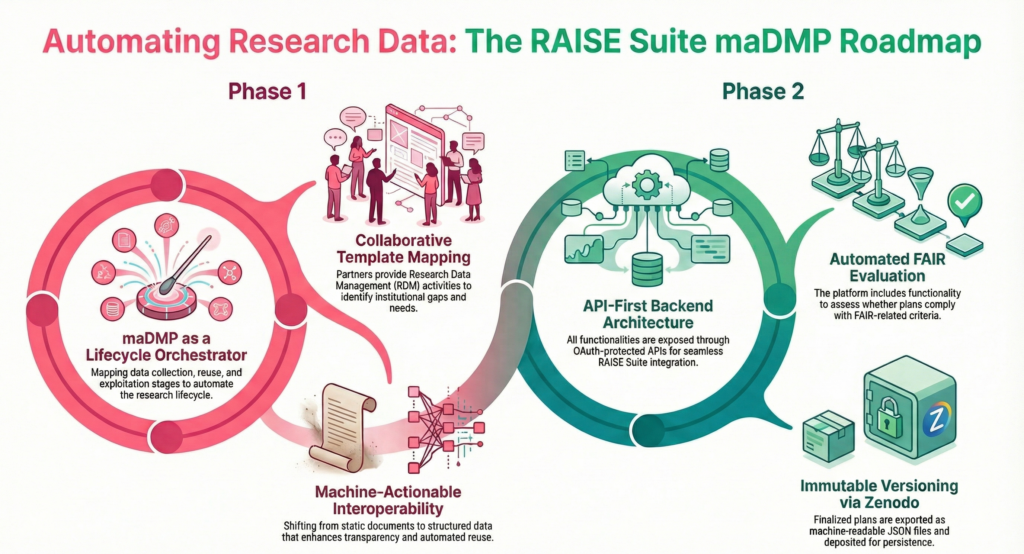
On February 2, 2026, a dedicated webinar was held to agree with partners on the methodology for developing the machine-actionable DMP for RAISE Suite. Partners from the Lab of Medical Physics and Digital Innovation (AUTH) presented the overall approach and objectives in using the maDMP as an orchestrator for data management in the RAISE platform, placing particular emphasis on mapping the key stages of the research lifecycle, such as data collection, planning, reuse, and exploitation.
To support this process, partners were provided a structured Excel template of detailed Research Data Management (RDM) activities, which they were asked to complete according to their own data management practices. Their input is essential to capture diverse needs across institutions and identify common patterns and gaps, which will inform the development of the RAISE Suite ma-DMP application profile extension.
Building on this, OpenAIRE shared know-how from active contribution to the development of the RDA maDMP and common API. They introduced the main components of machine-actionable DMPs, highlighting how structured, interoperable data management can enhance transparency and reuse, and how these are becoming available in and adopted by ARGOS. OpenAIRE also demonstrated how these components are expected to be enriched and integrated into the RAISE Suite, enabling a more dynamic and automated approach to data management. Overall, the webinar helped all partners to align with the maDMP concept and provided a clear roadmap with actions marking an important step toward establishing a cohesive and scalable data management framework within the project.
Technical Deep Dive: ARGOS/OpenCDMP Swagger Technical Meeting
To build upon the webinar’s foundation, a technical coordination meeting followed on March 10, 2026, chaired by Elli Papadopoulou (OpenAIRE), to discuss the ARGOS/OpenCDMP maDMP API developments and first integration needs of the RAISE Suite consortium. The meeting aimed to support technical partners in using the maDMP API and the OpenCDMP/ARGOS API, as well as identify what is needed to support data workflows being designed in the RAISE Suite project.
Key technical insights and capabilities discussed include:
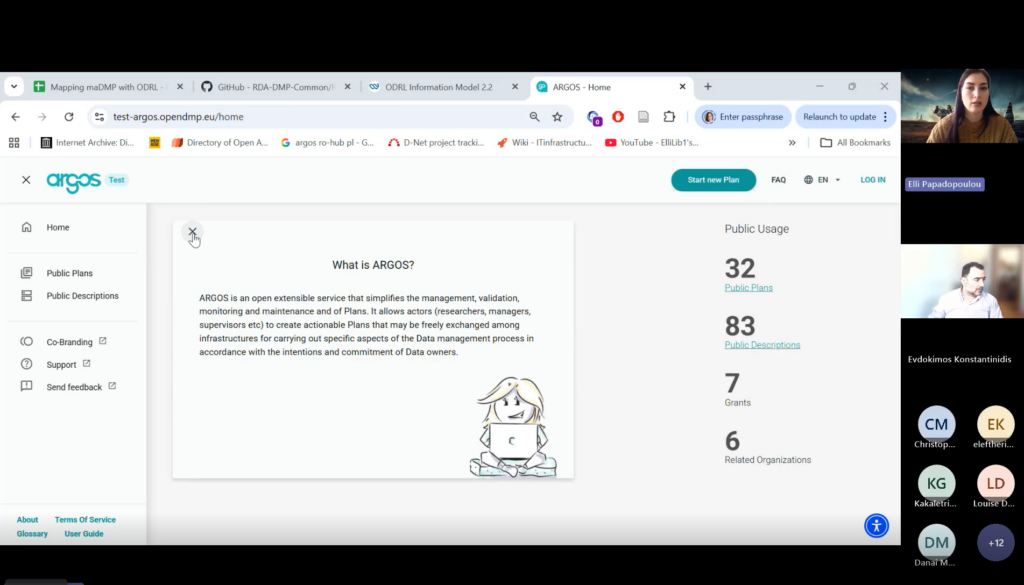
- ARGOS / OpenCDMP Capabilities: The platform was presented through a test instance, highlighting that it is a multi-tenant environment where blueprints define the structure of a plan and templates provide the questions to be answered. Plans can capture more than data management information, including software, ethics, policy, and other research-related information. Furthermore, the platform can prefill information from external sources such as ORCID, ROR, funding sources, and other configured services.
- Dynamic Structure and Evaluation: The structure of a plan is dynamic and driven by the blueprint. The core platform is generic and is not built natively on the maDMP model. Compatibility with the maDMP standard is achieved through mappings, which means full compatibility may require some design compromises. The platform also includes evaluation functionality that can assess whether a plan complies with certain criteria such as FAIR-related checks.
- Publication and Versioning: Plans can be exported in different formats and deposited to Zenodo, including a PDF and a machine-readable JSON representation. Once a plan is finalized and deposited, it becomes immutable in ARGOS. The discussion clarified that retrieval of machine-readable content is linked to the published record and related PID-based workflows, rather than direct retrieval from inside ARGOS itself. Any update requires creation of a new version, and the Zenodo integration also supports publishing a new version of the deposited record.
- Extensions and Lifecycle Stages: The group discussed how to include RAISE-specific low-level fields, such as collection-related sensor information. While the platform does not use RDM lifecycle phases in exactly the same way that RAISE currently conceptualises them, similar functionality can be achieved through templates, plan statuses and workflows in ARGOS. The initial idea was to create separate templates for data collection and processing, incl.
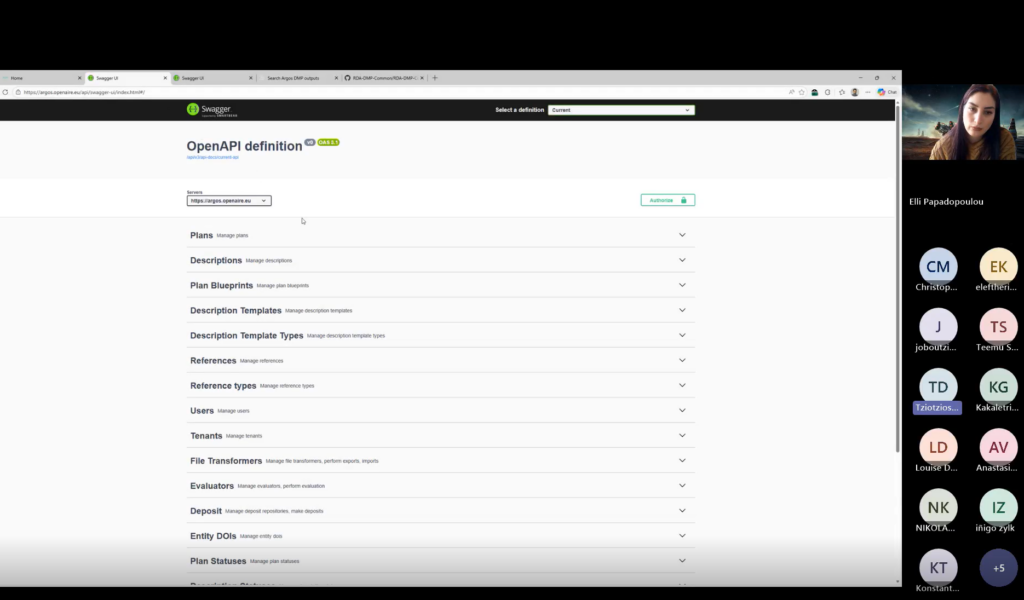
- API Exposure and Authentication: All ARGOS functionalities are exposed through APIs, including operations for querying plans, retrieving plans, creating or updating plans, exporting plans, creating versions, and working with descriptions and blueprints. This makes it possible for RAISE to build its own interface while using ARGOS/OpenCDMP as the backend. The APIs are protected through OAuth, currently using Keycloak with OpenAIRE AAI, and future compatibility work with EOSC AAI was also mentioned.
Next Steps and Implementation Priorities
The consortium agreed that ARGOS / OpenCDMP already provides a strong basis for RAISE integration. The next phase should narrow the technical scope to the minimum viable integration points needed for implementation. Moving forward, the most immediate work should focus on the practical use of the APIs, publication and retrieval workflows for machine-readable DMPs, and the structure of templates and any required extensions.