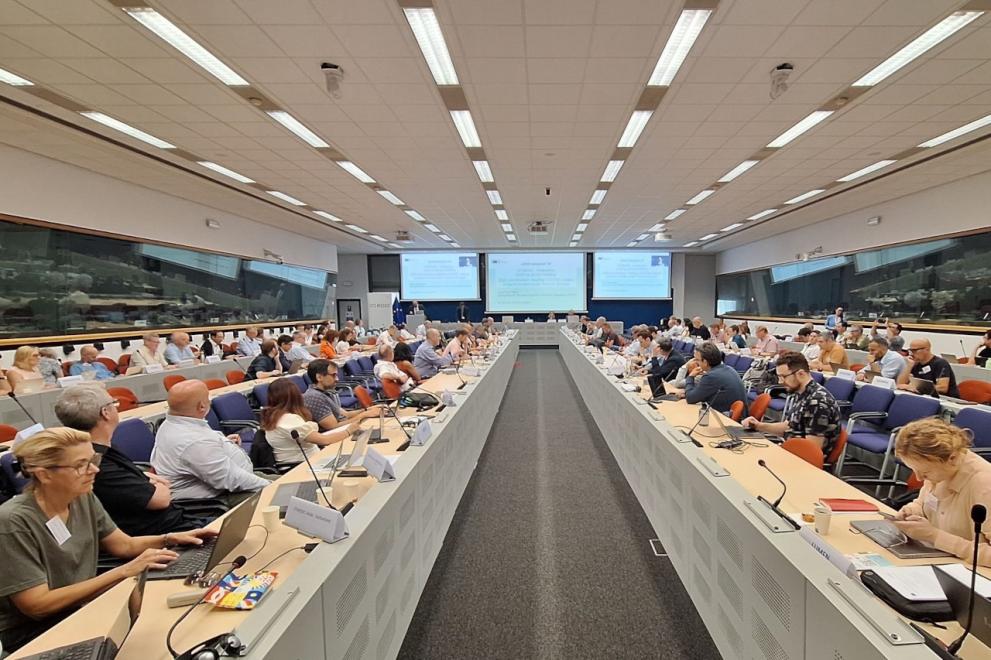
The RAISE family proudly participated in two inspiring days in Brussels, on 7–8 July 2026, at the 2026 Coordination Meeting of EOSC-related projects funded under Horizon Europe. Representatives from AUTH Medical Physics & Digital Innovation Lab, ENoLL, OpenAIRE and Innov-acts joined the meeting, contributing to discussions on the European Open Science Cloud (EOSC).
Organised by the European Commission, the event brought together 34 EOSC-related projects, the EOSC Association, EOSC Nodes, and members of the wider EOSC community, creating a dynamic environment for knowledge exchange, collaboration, and strategic dialogue.
As EOSC continues its transition towards an operational Federation, the meeting provided a valuable platform to share experiences, strengthen connections, and jointly explore the next steps for the Federation, including how to build on existing investments and sustain their impact in the context of the forthcoming FP10 framework.
Shaping the FAIR Data Ecosystem
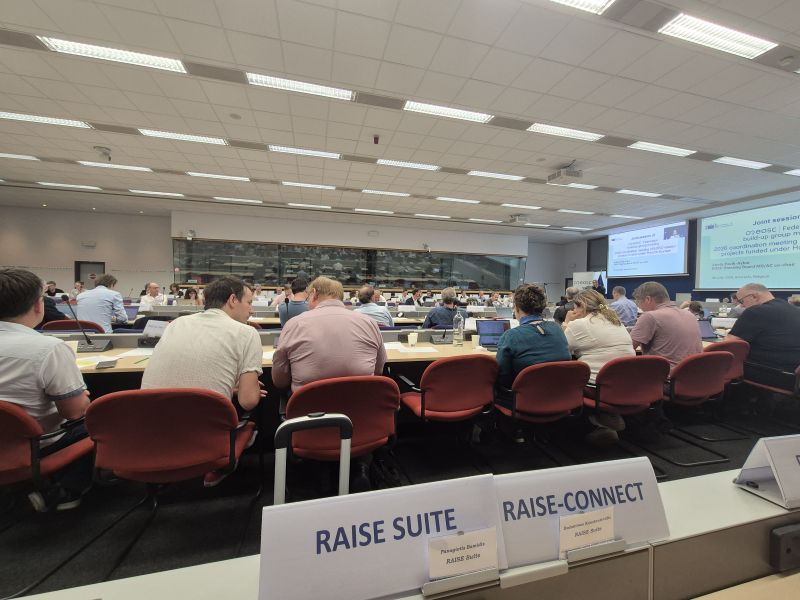
A major highlight for our project was the breakout session on “FAIR Data ecosystems and scientific uptake.” Our Project Coordinator, Evdokimos Konstantinidis, delivered a thought-provoking opening contribution alongside Friederike Schmidt-Tremmel (OSCARS), with excellent rapporteur support from Simon Hodson (CDIF4EOSC).
During this session, the RAISE Suite team presented critical insights bridging our past, present, and future initiatives:
- Lessons Learnt: We shared actionable strategies for long-term adoption and sustainability derived from the successes of RAISE Science and RAISE Suite.
- Looking Ahead: We introduced the core concept driving RAISE Connect: Digital Objects over MCP, highlighting its potential to reshape how research data is accessed and utilized within the EOSC framework.
Three Key Takeaways for the EOSC Community
The discussions yielded highly constructive insights for the future of Open Science in Europe. Three core messages stood out:
- FAIR is About People: Successful implementation relies on culture as much as technology. Driving adoption requires engaging research communities from the start, making solutions intuitive, and recognizing that different scientific disciplines interpret FAIR principles differently. Research assessment reform will be vital in driving this cultural shift.
- Sustainability Demands Clear Pathways: Project success alone is not enough. Technical interoperability must be paired with clear onboarding pathways into the EOSC Federation, sustainable ownership models, robust governance, and long-term business planning.
- Collaboration Must Be Systematic: We need to move beyond ad-hoc sharing. There is a pressing need for structured matchmaking mechanisms to connect project needs with existing solutions, strengthen dialogue between EOSC Nodes and projects, and coordinate joint outreach to new research communities.
Connecting Communities, Not Just Services
One conclusion resonated throughout the entire event: building the EOSC Federation is not just about connecting services, it is about connecting communities. The next phase of EOSC will depend entirely on our collective ability to transform project results into sustainable, widely adopted solutions that deliver lasting value for European researchers.