Food Waste Management Real-Life Data Collection Use Case

Adaptation to Climate Change Mission

What the Canteen Throws Away

Every meal served leaves a trail of data about the food we waste.

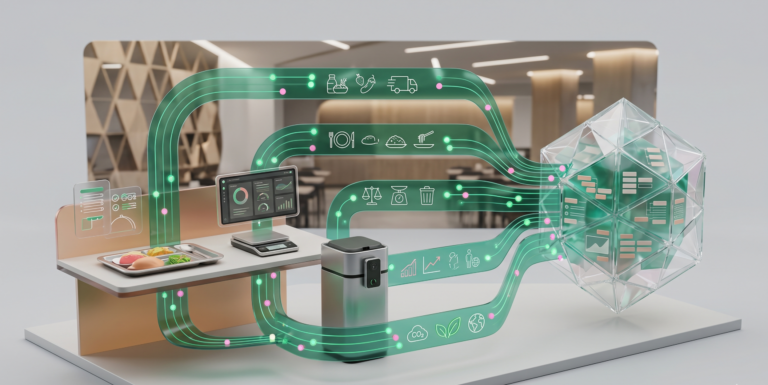
This RAISE Suite use case turns plate, kitchen and overproduction waste at the BarLaurea living lab into open, FAIR-by-design data, and tests how gamification can help cut it.

At a glance

Pilot Period

M6 – M40

(Feb 2026 – Dec 2028)

Domain

Food Systems / Behavioural Science

Location / Study Sites

BarLaurea Campus Restaurant, Espoo, Finland

Participants / Scale
  • ~275 daily customers on average, with numbers ranging from 80 to 600 (anonymous).
  • 3 permanent staff members, 3 management interns, and ~50 rotating first‑ and second‑year students, with 10 trainees participating at a time.

Main Goal

This Use Case study collects longitudinal data on plate waste, kitchen waste, and overproduction waste within the BarLaurea campus restaurant living lab, examining their relationship to menu offerings.

Periodic food waste reduction interventions are implemented to systematically assess and compare the effectiveness of different intervention strategies over time. The study further aims to develop a practical, evidence‑based protocol for buffet‑style restaurants to more effectively monitor and manage food waste. The resulting dataset will be made available as an open database to support transparency, replication, and further research.

Domain Challenges

  • A significant, overlooked source of waste: Reducing food waste is a key EU objective, yet restaurants account for around 11% of total food waste. In Finland, the dominance of buffet lunches makes buffet restaurants a particularly significant contributor.
  • Structural pressures drive waste: Buffet settings face built-in challenges, like demand uncertainty, overproduction, and portioning behaviours that increase plate waste, making waste hard to predict and consistently measure across the kitchen and dining floor.
  • Fragmented data limits progress: Data from buffet restaurants remains scattered and unstructured, so effective reduction strategies can’t easily be evaluated, compared, or scaled to other sites.

Keywords

food waste, food management, reduction, leftovers, meals

Key Figures & Facts

Data types
  • Food supply quantities,
  • Plate and kitchen waste amounts,
  • Behavioural change indicators 
Platform
  • The BarLaurea campus restaurant living lab in Finland
  • Data flows into the RAISE Suite Local Agent pipeline for processing and publication
Monitoring period
A 9-month study with continuous daily collection across repeated challenge cycles.
 
Approach & Expertise
  • A gamified strategy, using the GameBus platform to engage students and canteen staff and drive sustainable behaviour change
  • An average of 275 daily customers at BarLaurea, with rotating groups of about 50 participating students.
  • Operational and behavioural data are linked at the day × meal-service level and standardised into a FAIR-ready structure (a modest 100–500 records/day).


Data Sources
  • Anonymous plate-waste scales
  • Kitchen management system exports
  • Daily menu and ingredient records
  • GameBus activity logs.

Use Case Implementation Phases

October 2026 – September 2027
Data Collection Without RAISE
A baseline and intervention cycle using existing canteen systems and the GameBus platform, without full RAISE integration. Daily waste, menu, and participation data are collected across repeated gamified challenge cycles, establishing the reference patterns against which RAISE Suite's impact will be measured.
October 2026 – September 2027
January–June 2028
SDK Integration & RAISE Onboarding
The data structure and lessons from Phase 1 are used to integrate with the RAISE SDK/Agent workflow, validating schema compatibility, data transfer, and metadata handling for FAIR-by-design data collection.
January–June 2028
June - September 2028
Data Collection with RAISE
The use case compares baseline and intervention periods, publishes a cleaned, documented open dataset, and finalises a reusable protocol so other canteens and restaurants can replicate the approach.
June - September 2028

Use Case Outcomes

An Open Food-Waste Dataset

FAIR, Reusable Across Dining Sites

An open, FAIR dataset linking food-waste amounts, meal variations, and staff behaviour to menu offerings, reusable by other dining institutions.

A Behaviour-Change Framework

Describing What Drives Reduction

A framework describing how behavioural interventions drive real waste reduction, designed for replication across other sites and settings.

A Reusable FAIR Toolkit

Protocol, ma-DMP and Validated SDK

A reusable data-collection protocol and ma-DMP, plus validated RAISE Suite SDK integration across kitchen management and gamification systems.