By RAISE Suite team
Picture the Data Management Plan you wrote for your last project. It was a smooth ride on paper. You defined the data, planned collection, storage, metadata, sharing and compliance.
Now picture how it actually went. The scope changed. Formats got messy. Metadata went missing. Months disappeared into reprocessing and manual fixes. By the end you had usable data, but mostly thanks to lessons learned the hard way.
That gap between plan and reality is what we talked about with data stewards at OpenAIRE’s FAIR RDM Train-the-Trainers Bootcamp in October. It is also the problem RAISE Suite was built to solve.
Why researchers still don’t share
The evidence is clear. The European Commission’s European Research Data Landscape report shows the same barriers again and again:
- concerns about data protection
- fear that data will be misinterpreted or misused
- lack of recognition for sharing
- not knowing where to put the data
None of these is solved by telling researchers to “be more open.” They are solved by infrastructure that makes openness safe.
Step one: trust through data visiting
That is what our predecessor project, EOSC-RAISE, set out to build. It works like a home-rental platform, but for research data. Data owners keep their datasets on their own premises, or on a certified node. Researchers don’t download the data. They send their algorithm to it.
Here is how it works in practice:
- The researcher develops their code on a sample of the dataset.
- The code runs inside a Trusted Execution Environment.
- The result is registered with a blockchain-backed persistent identifier, so anyone can verify it was really produced from that data.
The data owner decides who can process their data, what becomes visible, and whether results are released. That gives them sovereignty over their data while still making it usable.
It is already working. The RAISE Portal platform counts nearly 200 users, almost 400 datasets and more than 750 experiments. Public bodies such as the Region of Central Macedonia are using it to open their data to researchers. Researchers who used RAISE also reported real shifts in attitude: less worry about misuse and misinterpretation, and a stronger sense of recognition and career benefit from sharing.
Step two: Open Science starts before the dataset exists
There was still one gap. Even trusted sharing begins after a dataset exists, and by then much of the damage from the plan-vs-reality problem is already done.
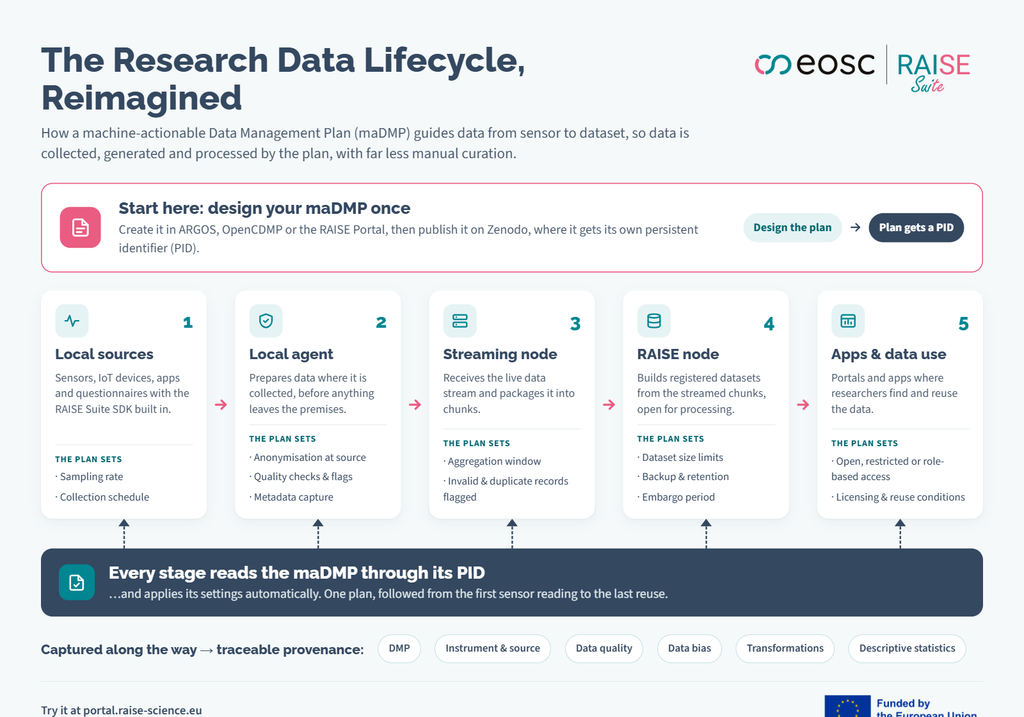
RAISE Suite moves upstream to the moment data is created. The key is the machine-actionable DMP (maDMP).
Instead of a document filed away for the funder, the maDMP becomes the rulebook for the whole data journey:
- Design the plan. Create your maDMP in a tool such as ARGOS, OpenCDMP or the RAISE Portal, then publish it with its own persistent identifier.
- Connect your instruments. Integrate the RAISE Suite SDK into your sensor, app or questionnaire, and point it to your DMP.
- Let the plan do the work. Every stage reads the DMP through its identifier and applies its settings automatically: (a) sampling rates, (b) anonymisation at the source, (c) quality checks, (d) aggregation, (e) retention, (f) embargo periods, and (g) access and reuse conditions
Along the way, RAISE Suite captures the metadata people usually forget, so every dataset arrives with a provenance trail:
- source and instrument details
- data quality and bias indicators
- transformations applied
- descriptive statistics
maDMPs can be shared, too. A whole team can collect data under one plan. Separate groups can also follow identical rules independently, so their datasets can be combined later. To get people started, we’ve published 504 representative data management actions across 13 phases on Zenodo.
Testing it where it counts
We are putting this to the test in five real-world pilots:
In each one, partners integrate the SDK, create a maDMP, and collect data in real settings.
Why data stewards matter here
Tools only change practice when people know how to use them and how to teach them. That’s why the OpenAIRE Bootcamp mattered to us. Data stewards are the people researchers turn to when they write their next DMP. If they see that a plan can actually run data collection, that idea travels to every team they support.
Want to try it? The RAISE Portal is live at portal.raise-science.eu, and the documentation is at documentation.raise-science.eu. We’d love to hear from data stewards who want to test it with their research communities: info@raise-science.eu.