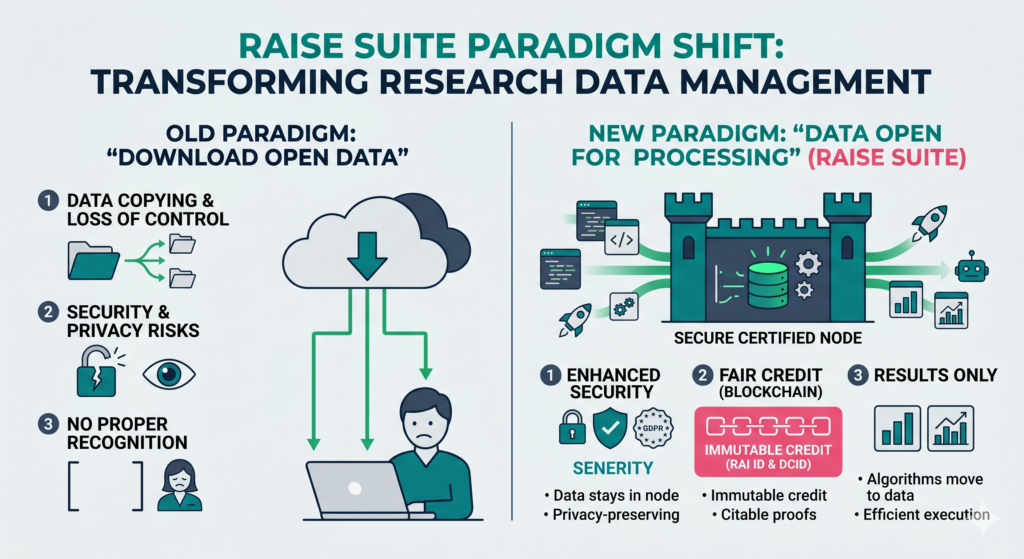
For decades, the vision of Open Science has been heavily tied to one primary action: making datasets downloadable. The vision was straightforward: a researcher in Helsinki could access data collected in Athens, download it, analyze it, and publish their findings.
In theory, it was a beautifully simple model. In practice, this legacy approach has quietly accumulated a set of systemic problems that the research community can no longer afford to ignore.
The Hidden Costs of Downloading Data
When you download a dataset, you are fundamentally making a copy. That copy travels across networks, lands on a laptop, gets processed in software the original data owner never approved. This creates two critical points of friction in modern research:
- The Accreditation Deficit: The researcher who originally collected the data, often at great personal, financial, and institutional cost, frequently receives no direct credit for enabling subsequent discoveries.
- The Security Dilemma: If a dataset contains sensitive information, such as patient records, location tracking, or personal identifiers, the concepts of “downloadable” and “safe” are in direct tension.
The result is a flawed ecosystem. Sharing data openly often forces researchers to choose between giving their hard work away without recognition, or keeping it locked away entirely out of privacy concerns. Neither outcome serves the advancement of science.
The RAISE Suite Approach: Moving Algorithms, Not Data
RAISE Suite is built around an entirely different premise to resolve this tension: Instead of moving data to the algorithm, RAISE Suite moves the algorithm to the data.
Consider a museum that houses a rare, fragile manuscript. > In the old model, the museum photocopies the manuscript and posts the copies to researchers worldwide. They immediately lose control of where those copies end up, who uses them, and for what purpose.
In the new model, researchers come to the museum, work with the manuscript securely on-site, and leave only with their insights and findings. The manuscript never moves. Its provenance remains intact. Its custodian is properly credited.
This is precisely what the RAISE Suite architecture enables for research data. Through a network of Streaming Nodes and a Software Development Kit (SDK) embedded directly into data collection instruments, algorithms are sent directly to where the data lives. The data is processed securely within a privacy-preserving environment, and only the final, aggregated results travel back to the researcher.
The Infrastructure Powering the Shift
This paradigm shift, initially established by the EOSC-RAISE project, is now fully integrated into the RAISE Suite to cover the entire data lifecycle. We achieve this through a robust, decentralized architecture:
- Crowdsourced Secure Nodes: Data is captured in real-time via RAI Streaming Nodes (RSN) and securely stored on RAI Certified Nodes (RCN). Raw data never leaves these secure environments.
- Machine Actionable DMPs (ma-DMP): Acting as the intelligent “orchestrator,” the ma-DMP automatically configures processing workflows without requiring manual intervention, ensuring compliance and efficiency from the start.
- Immutable Blockchain Accreditation: When a researcher uploads a processing script to an RCN, the resulting experiment is automatically registered on a blockchain network. This provides immutable, citable proofs, via RAI IDs and Data Collection Identifiers (DCIDs), ensuring proper recognition for both the data owners and the algorithm creators.
- Synthetic Data for Safe Development: How do researchers write scripts for data they cannot directly see? The RAISE Suite provides synthetic versions of the data that perfectly mimic the original dataset’s statistical properties, allowing researchers to develop and test their algorithms securely before deploying them on the real, sensitive data.
A New Definition of Openness
The transition to “data open for processing” is not merely a technical upgrade; it is a fundamental renegotiation of what openness means in the digital age. By automating FAIR (Findable, Accessible, Interoperable, and Reusable) compliance at the instrument level and embedding security by design, the RAISE Suite is proving that Open Science can finally be fully compatible with rigorous data protection, uncompromised trust, and guaranteed recognition for the researchers driving innovation forward.