Stroke Transitional Care Use Case
Cancer Mission
The Gaps Between Care
A patient's hardest moments often come between one care setting and the next.
This RAISE Suite use case links real-world activity data with quantified rehabilitation exposure, supporting clinical decisions at the transitions where continuity of care is most fragile.
At a glance
M6 – M40
(Feb 2026 – Dec 2028)
Health — Transitional Care & Neurorehabilitation
- Thessaloniki (GR)
- Valladolid (ES)
- Montreal (CA)
- 60 patients across three clinical sites
Main Goal
This use case investigates how real-world physical activity and quantified exposure to rehabilitation interventions relate to changes in clinical and patient-reported outcomes, supporting decision-making in transitional care.
The moments when a patient moves from hospital to home, or from inpatient to outpatient rehabilitation, are where continuity of care is most easily lost. By combining wearable-derived digital biomarkers, clinical assessments, patient-reported outcomes, and data on the rehabilitation that patients actually receive, the pilot captures how functional status evolves through these transitions, and gives clinicians the evidence to act on it.
The study is designed as a prospective, multi-site pragmatic cohort study with a structured intervention framework applied across all sites.
Domain Challenges
- Care that spans disconnected settings: Patients move between hospital, home and rehabilitation centres, but the data follows them poorly, leaving clinicians with an incomplete picture at exactly the moments decisions matter most.
- Rehabilitation exposure goes unmeasured: How much therapy a patient actually receives, and how they engage with it, is rarely quantified, making it hard to link intervention to outcome.
- Data locked behind regulation and fragmented tools: Strict privacy rules limit exchange between institutions and across borders, while devices, questionnaires and clinical records sit in separate systems with no common structure.
Keywords
health, stroke, transitional care, neurorehabilitation, rehabilitation, multimodality, digital biomarkers, wearables, smart devices, patient-reported outcomes, data privacy, data interoperability, FAIR data
Key Figures & Facts
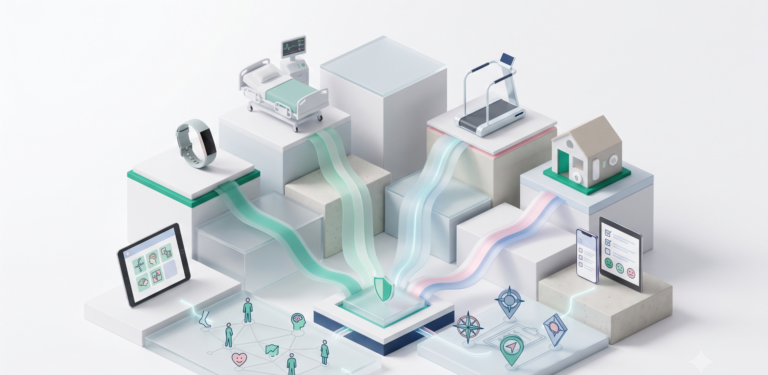
The pilot adopts a multimodal, clinically integrated approach across three sites, AUTH (Greece), INTRAS (Spain) and McGill (Canada), combining clinical outcomes, patient-reported questionnaires, daily smart-device data, and quantified rehabilitation exposure captured through the Gradior Suite.
Explore the interactive image below for the full picture of what is collected, how, and with which tools.

60 patients across three clinical sites in Greece, Spain and Canada.
Three care settings:
- hospital
- home
- rehabilitation
with the RAISE Suite SDK deployed close to the data sources.
Four streams:
- pre- and post-intervention clinical outcomes
- pre- and post-intervention questionnaires
- daily smart-device data
- quantified rehabilitation intervention data
Wearables and smart devices capturing real-world physical activity and digital biomarkers across all three care settings.
The questionnaires to be used are:
- Mobility (Berg Balance Scale, Functional Gait Assessment)
- Mental and emotional strain (PHQ-9)
- Quality of life (PROMIS-29/SF-12, EQ-5D-5L)
A neuropsychological intervention platform supporting rehabilitation across cognitive, physical, sensorial-emotional and social dimensions — contributing quantified therapy exposure data.
A shared machine-actionable Data Management Plan (ma-DMP) harmonises this study with the Cancer use case for cross-site analysis, following a prospective, multi-site pragmatic cohort study with a structured intervention framework applied across all sites.
Use Case Implementation Phases
Data Collection Without RAISE
SDK Integration & RAISE Onboarding
Data Collection with RAISE
Use Case Outcomes
Decision Support at the Transitions
Linking Activity, Therapy and Outcomes
A multimodal dataset connecting real-world activity and quantified rehabilitation exposure to clinical and patient-reported outcomes, supporting decisions in transitional care.
A Harmonised Collection Protocol
One ma-DMP, Three Countries
A common, FAIR-by-design data collection protocol validated across transnational sites in Greece, Spain and Canada, assessed for data quality and interoperability.
FAIR Data in a Regulated Field
Interoperable, Compliant, Reusable
Proof that RAISE Suite can deliver interoperable, high-quality health data collection under strict privacy regulation, including sharing beyond the EU.
